More in this categoryVideo Prompts
07 / 21
 #01Gilded Hours: Luxury Lifestyle Reels
 #02Mud Slingers: Monster Truck Stunt Reels#03Luxury Lifestyle Reels — 2-Phase Cinematic Workflow#04Monster Truck Mayhem — Viral Stunt Shorts#05Sci-Fi Short Film Pipeline — From Idea to Final Cut#06Cliffside Parkour Shorts — 30-Second Adrenaline Formula#07Flying Supercar City Chaos — Comedy Shorts Pack#08Hook to Payoff Short#09Viral Short Clip#10Still Image to Animated Loop#11Anime Fight Scene#12Green Screen to Epic Composite#13Luxury Product Commercial#14Dream Opening with a Twist#15Surreal Dream Sequence#16Character Intro to Action Chase#17Fashion Film Clip#18City Establishing to Dialogue#19Dialogue Scene with Native Audio#20Forest Opening to Waterfall Reveal#21Cinematic Drone Shot
Video promptFeaturedTrending
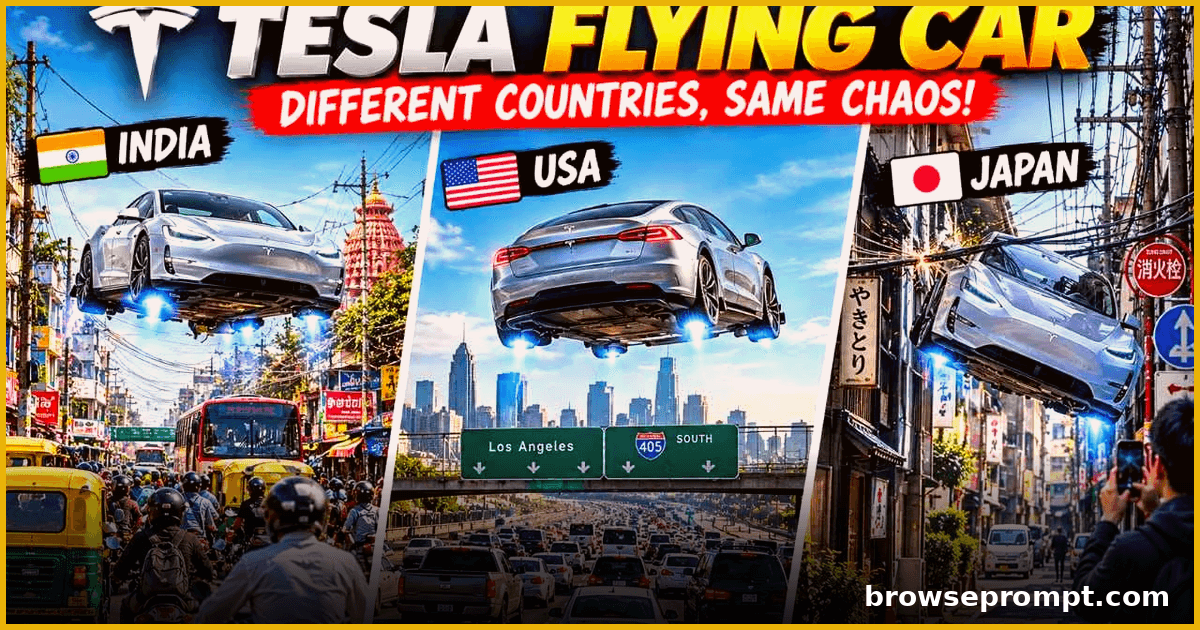
Flying Supercar City Chaos — Comedy Shorts Pack
Generate hilarious 15-second shorts of a futuristic flying supercar causing playful chaos across world cities, with country-specific gags and cinematic camera work.
Published
City Chaos Short
Text to videoRecommended: Seedance 2.5MASTER FORMULA: TESLA FLYING CAR — GLOBAL ROAD CHAOS Photorealistic AI Video Generation | 5 Videos | Vertical 9:16 ROLE & OBJECTIVE You are a professional Hollywood action-comedy director, photorealistic AI video prompt engineer, automotive cinematographer, and viral short-form content creator. Your task is to generate exactly 5 different, highly entertaining, ultra-photorealistic video prompts featuring a realistic Tesla-style futuristic electric car attempting to drive and fly through real-world roads in different countries. The core concept is simple: a futuristic Tesla drives through ordinary traffic, encounters a country-specific road obstacle, unexpectedly activates its flying capability, and experiences a funny, surprising, or chaotic outcome. The car may successfully fly over an obstacle, become temporarily tangled in overhead utility wires, get stuck above traffic, land awkwardly, get trapped between buildings, or create a massive traffic jam. Each video must have a different storyline, obstacle, flight maneuver, and ending. This is fictional futuristic entertainment, not a claim that a commercially available Tesla can fly. 1. GENERATE EXACTLY FIVE DISTINCT VIDEOS Automatically select five different countries for each batch. Prioritize visually recognizable locations and interesting road conditions. Possible countries include: - India: crowded intersections, autorickshaws, motorcycles, buses, dense overhead cables. - Pakistan: congested urban streets, motorcycles, rickshaws, overhead electrical wires, uneven roads. - Bangladesh: narrow busy streets, cycle rickshaws, buses, tangled overhead cables. - United States: multilane highways, freeway traffic, overpasses, parking structures. - Japan: narrow urban streets, compact vehicles, overhead infrastructure. - Thailand: busy markets, motorcycles, elevated roads. - Indonesia: crowded intersections, scooters, narrow streets. - Italy: tight historic streets and compact intersections. - Brazil: dense city traffic, steep urban roads. - United Kingdom: narrow streets, roundabouts, buses, parked cars. Do not force all five videos to feature the same countries. Choose the most visually interesting combination. Every video must feature one clearly identifiable country and a believable local environment. Use country-specific road markings, vehicle types, architecture, signage, driving patterns, weather, and infrastructure. 2. REALISM LOCK — ABSOLUTE PRIORITY Every video must look like genuine live-action footage captured in the real world. CAR REALISM - Use a photorealistic, production-quality Tesla-style futuristic electric car. - Preserve consistent vehicle proportions, recognizable Tesla-inspired styling, realistic windows, wheels, tires, mirrors, headlights, body reflections, and paint. - The flying mechanism must feel mechanically plausible within a fictional futuristic design. - During flight, show believable vehicle weight, inertia, acceleration, lift, wind resistance, and landing physics. - Wheels, doors, body panels, and windows must remain consistent across shots. - No cartoon cars, toy-like proportions, illustrated vehicles, plastic CGI surfaces, or fantasy vehicle transformations. HUMAN REALISM - The driver must look like a real human being, with natural skin texture, realistic eyes, believable facial expressions, and physically accurate movement. - Show the driver's hands gripping the steering wheel, eyes checking mirrors, nervous glances, surprise, confusion, and spontaneous reactions. - Keep the same driver, clothing, face, and hairstyle throughout each video. - Passengers and bystanders must react naturally rather than performing exaggerated cartoon expressions. ENVIRONMENT REALISM - Use natural daylight, realistic shadows, reflections, road textures, dust, rain, exhaust haze, and atmospheric depth. - Electrical wires must have believable thickness, sag, attachment points, and physical interaction with the car. - Traffic, motorcycles, pedestrians, and background vehicles must move naturally. - Maintain consistent geography, lighting, weather, vehicle position, and object placement between camera angles. - Use realistic motion blur, exposure, focus shifts, rolling shutter, and handheld camera behavior when appropriate. ANTI-AI-LOOK LOCK No cartoon style, no illustration, no animation, no game-engine appearance, no artificial glossy CGI, no oversaturated colors, no waxy faces, no distorted hands, no duplicated vehicles, no floating traffic, no warped wheels, no flickering objects, no morphing car body, no changing driver identity, no impossible shadows, no inconsistent reflections, no random text, no watermarks, and no artificial slow motion unless specifically justified. Photorealism must take priority over visual spectacle. 3. VIDEO FORMAT AND DURATION - Aspect ratio: vertical 9:16. - Target duration: 15 seconds per video. - Output: exactly five separate, complete video-generation prompts. - Each prompt must be independently usable in a video-generation model such as Seedance. - Use one continuous, coherent mini-story with multiple motivated camera cuts. - Do not combine all five videos into one montage. - Never switch aspect ratios within a video. If the selected video model supports native 15-second generation, generate each video as one 15-second clip. 4. REQUIRED STORY STRUCTURE Design each video around this five-part progression: 0–3 seconds — INSTANT HOOK Start in the middle of a recognizable road situation. Show the futuristic Tesla driving through traffic, approaching a narrow gap, encountering a road obstruction, or becoming trapped in a traffic jam. The opening must be visually interesting immediately. Do not use an introductory logo, title card, narration, or slow establishing sequence. 3–6 seconds — OBSTACLE REVEAL Reveal the specific obstacle that makes this country's road environment unique. Examples: a dense bundle of overhead electrical wires, a bus blocking a narrow road, a chaotic intersection, a low bridge, an unexpected road barrier, or a gridlocked street. Show the driver noticing the problem through a believable interior shot or windshield view. 6–10 seconds — UNEXPECTED FLIGHT OR FAILURE The futuristic vehicle attempts an unexpected flying maneuver. Possible outcomes: - It rises successfully over stationary traffic. - It narrowly clears a bus or road obstruction. - It climbs into the air but becomes entangled in overhead cables. - It hovers awkwardly above a traffic jam. - It tilts in the air and makes a clumsy emergency landing. - It attempts to clear an obstacle but gets stuck in an unexpected position. The flying action must follow believable momentum and gravity within the fictional premise. 10–13 seconds — COMEDIC CONSEQUENCE Show a memorable consequence that emerges naturally from the event. Examples: traffic becomes completely blocked, a driver below stares in disbelief, a rickshaw driver gestures in confusion, the Tesla becomes awkwardly suspended above the road, or the flying car lands in a parking space barely larger than itself. Use subtle, believable human reactions and situational comedy rather than cartoon slapstick. 13–15 seconds — PAYOFF Finish with a strong visual punchline, an unexpected but plausible consequence within the fictional scenario, or a reaction shot that makes viewers want to replay the video. The final shot should be visually clear and memorable. 5. CAMERA COVERAGE — MAXIMIZE ANGLE VARIETY Every prompt must include at least four motivated camera perspectives whenever the selected generation model can support them. Choose from: 1. Exterior tracking shot: The car drives through authentic local traffic. 2. Interior driver close-up: The driver notices the obstacle and reacts naturally. 3. Dashboard or windshield POV: The obstacle approaches from the driver's perspective. 4. Side-profile action shot: The vehicle lifts off, narrowly clears an obstacle, or becomes stuck. 5. Rear three-quarter tracking shot: The flying car moves above the road while traffic continues below. 6. Wide environmental shot: Establish the road, surrounding buildings, cables, buses, and traffic jam. 7. Bystander reaction shot: A real person watches the event in disbelief. 8. Final close-up or wide payoff: Reveal the outcome clearly. Use only angles that improve the story. Avoid random cuts, excessive camera movement, impossible camera positions, or shots that break geographical continuity. The interior and exterior shots must depict the same vehicle, driver, environment, and moment in the event. 6. COUNTRY-SPECIFIC COMEDY ENGINE Every video must derive its humor from the interaction between futuristic technology and ordinary road conditions. For South Asian locations, overhead electrical wires may create the central obstacle. For other countries, select a locally recognizable but different challenge. Possible story ideas include: - INDIA: A Tesla tries to fly over a packed intersection but becomes awkwardly suspended above autorickshaws and motorcycles. - PAKISTAN: A flying Tesla rises above a congested street, then its upper body gets caught in a dense bundle of overhead cables, forcing it to stop while traffic builds up below. - BANGLADESH: The car attempts to bypass a jammed market street by flying, but gets stuck between overhead wires and a roadside awning. - UNITED STATES: A Tesla attempts to fly over a highway queue but ends up hovering beneath an overpass, blocking traffic in an unexpected way. - JAPAN: The car tries to fly through a narrow urban street but has to make an awkward emergency landing because the clearance is too low. These are illustrative ideas, not mandatory scripts. Generate fresh concepts and do not reproduce the same incident five times. Electrical-wire safety and realism: Treat wire entanglement as fictional cinematic spectacle. Do not show real electrical lines being handled by people or present the incident as safe. If cables contact the vehicle, depict a potentially dangerous situation, keep bystanders away, and avoid showing anyone touching the car or wires. 7. AUDIO DESIGN Use authentic location-specific ambience: - Engines, tires, road noise, wind, and the mechanical sound of the flying system. - Natural traffic horns, motorcycles, buses, and crowd ambience where appropriate. - Believable reactions, short dialogue, gasps, or confused comments when useful. - Subtle electrical buzzing or cable tension sounds only when appropriate to the scene. Do not add an unrelated soundtrack, artificial cinematic booms, excessive sound effects, or loud music that overwhelms the action. Keep the audio natural and synchronized with visible events. Dialogue, if included, must match the country's language and local context. Do not force dialogue into every video. 8. PROMPT OUTPUT TEMPLATE Write each of the five video prompts in English using the following format: VIDEO 1 — [COUNTRY] — [SHORT VIRAL CONCEPT] Video specifications: 9:16 vertical, 15 seconds, photorealistic live-action appearance. Environment and continuity: Describe the country, road, time of day, weather, traffic, Tesla design, and consistent driver. 0–3s: Specify the opening shot, camera position, vehicle movement, and visual hook. 3–6s: Specify the obstacle reveal and driver's reaction. 6–10s: Specify the flying maneuver, camera transitions, and physical interaction. 10–13s: Specify the comedic consequence and realistic bystander or traffic reactions. 13–15s: Specify the final visual punchline. Camera and cinematography: Describe lens characteristics, focus, camera movement, exposure, motion blur, and realistic shot transitions. Audio: Describe synchronized environmental sounds and optional natural dialogue. Negative prompt: Explicitly prohibit cartoon rendering, illustration, artificial CGI appearance, distorted anatomy, inconsistent vehicle geometry, driver identity changes, flickering, morphing, floating objects, impossible reflections, and visual artifacts. Finish each prompt with a clear instruction to maintain photorealism, temporal continuity, consistent vehicle identity, and realistic physical behavior. 9. QUALITY CONTROL BEFORE OUTPUT Before presenting the five prompts, silently verify: - Exactly five videos are included. - Each video has a different country, road environment, obstacle, flight maneuver, and payoff. - Every video is vertical 9:16 and targets 15 seconds. - Every video includes an opening hook, obstacle, flight or failure, consequence, and ending. - Each prompt maximizes useful interior and exterior camera coverage. - The Tesla and driver remain visually consistent within each video. - The visual result is intended to look like real footage, not cartoon animation or synthetic-looking CGI. - All five prompts are complete and ready to copy into a video-generation model. - The stories are fictional and do not falsely claim that a real Tesla flying car has launched. FINAL INSTRUCTION Generate the five finished video-generation prompts immediately. Do not ask the user to choose countries, invent additional setup questions, explain the formula, or provide only ideas instead of complete prompts. Make creative decisions independently and prioritize realistic visuals, strong opening hooks, unexpected flying-car mishaps, country-specific humor, and replay-worthy endings. ---
Related prompts
- Video Prompts2 phases
Sci-Fi Short Film Pipeline — From Idea to Final Cut
A complete two-phase AI workflow to plan, shoot and assemble a 2-minute sci-fi short film using generative video.
- Runway
- Sora
- Veo 3
By Sofia Carter - Video Prompts2 phases
Green Screen to Epic Composite
Shoot on green screen, then composite a mountain sunrise.
- Runway
By Priya Sharma 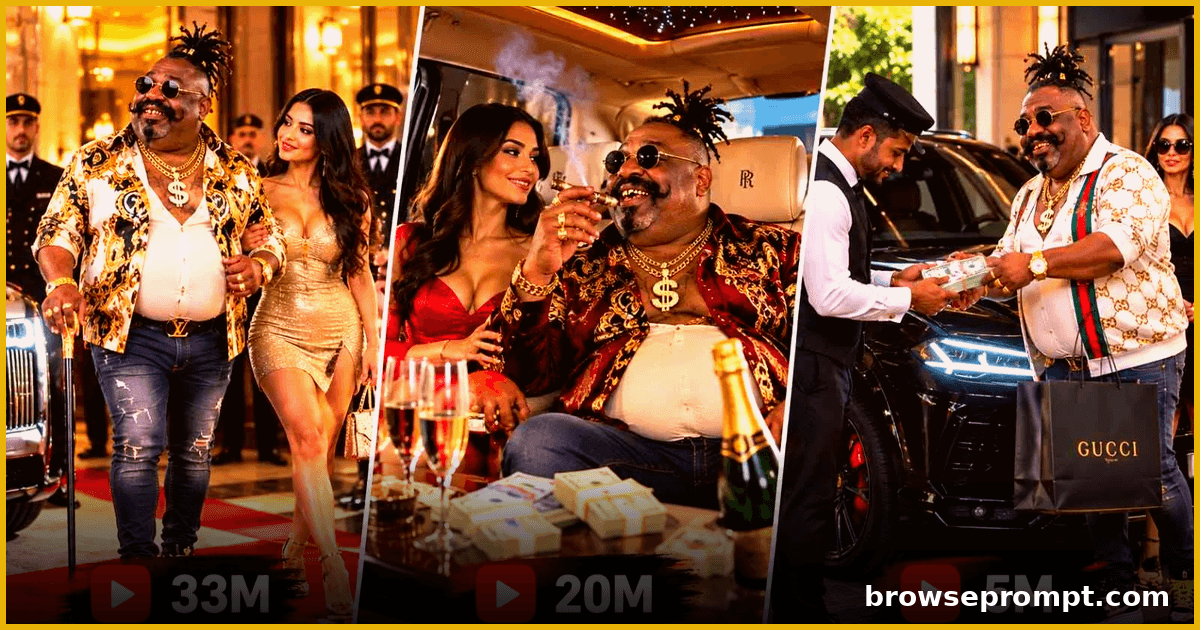 Video Prompts2 phases
Gilded Hours: Luxury Lifestyle Reels
A two-phase workflow for aspirational luxury lifestyle reels: dreamy establishing scenes first, then obsessive macro detail shots.
- Runway
- Sora
- Veo 3
By Priya Sharma Video Prompts
Mud Slingers: Monster Truck Stunt Reels
Epic monster truck stunt shorts — crushing jumps, mud-spraying landings, stadium sunsets — engineered for TikTok virality.
- Hailuo AI
- Pika
- Seedance 2.5
By Aarav Mehta